Rosalía

God lives in art. If you love art, you cannot deny God. To me, atheism empties a person’s eyes. An artist who struggles to believe makes life harder. Where do they think that channel comes from? The gift was no happy accident. Is there humility in denial? To see soul is to believe souls exist. Souls are divine. Divinity is beyond earth, beyond science. Music brings heaven to earth. How can a non-believer touch the soul of a melody that arrived here? Rosalía has become the conductor between realms.
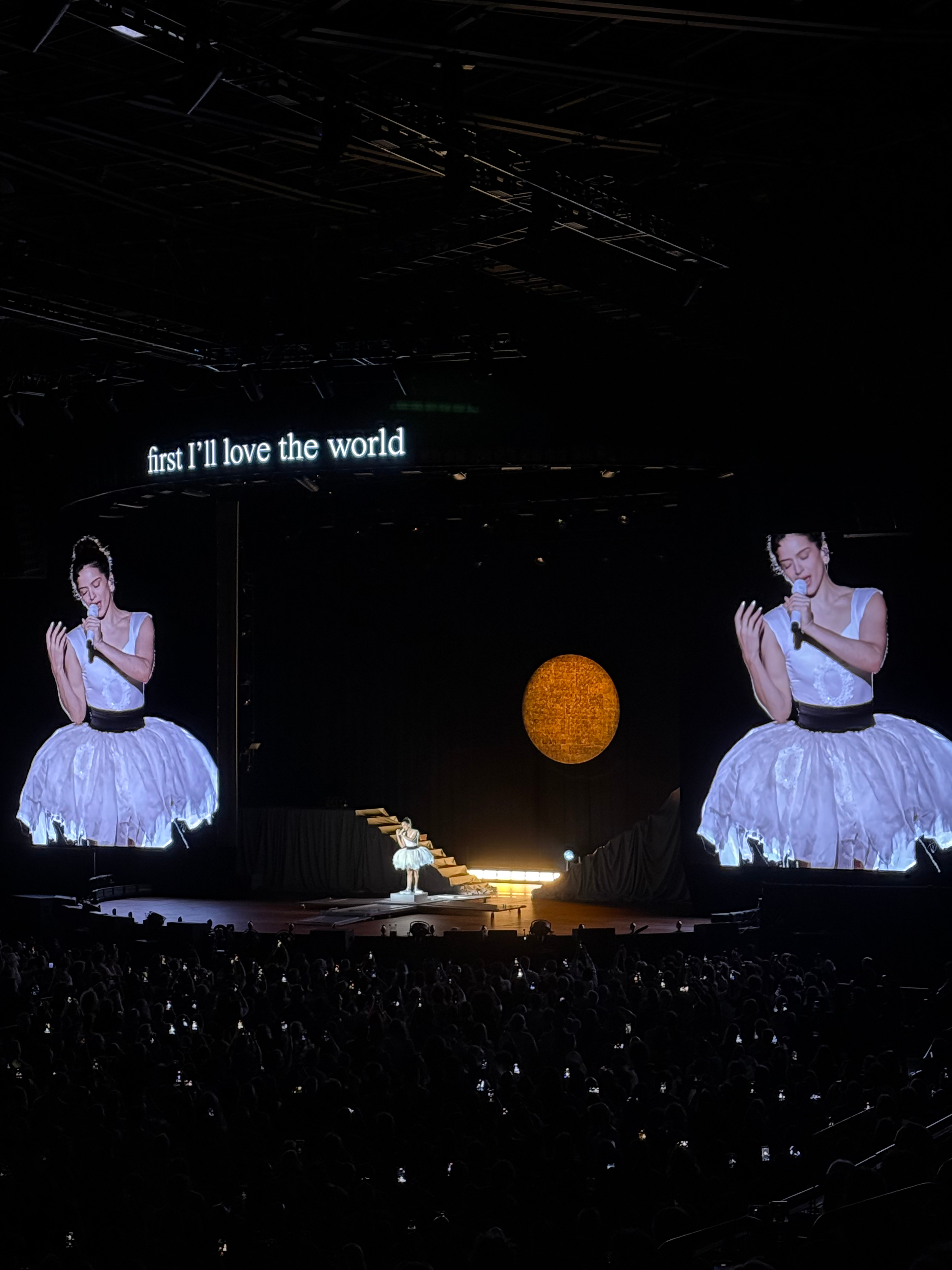
If you don’t yet know the Spanish superstar from Catalonia, Rosalía, she made flamenco chic when she came up in 2017 with a sacred art piece called Los Angeles. (Recently, she was also the only great surprise about Euphoria season 4). I was at her debut American show in 2019, which was followed a week later by her first Coachella performance. Again, I was there. She emerged a superstar. People were stunned by her, like they were discovering religion for the first time.
Writing about her reminds me of the last moments of the life I had before I was cancelled.
The last few years have immobilized me in many ways. I have had to sheath my heart to draw my sword. Spiritual belief felt necessary. Yet some days I lie paralyzed, wondering where that intoxicated writer has gone, the one who lived in the words, songs and impressions of great artists, chasing it down foreign alleyways and dark rooms. Perhaps, however, we confuse immobility for stillness. Perhaps I wasn’t stuck. Perhaps I was incubating.
When I heard Lux, Rosalía’s fourth album (November, 2025), I left my flesh prison. I remembered that there are infinite ways to say things, and in finding our own way, we free ourselves. The album is about many untouchable matters including romance and its problems, and the singer sought answers in the hagiographies of female poets and devout saints. In a world that picks apart Kardashians and Jenners, she sought long dead women of the cloth. On the track “Berghain”, Bjork comes in to comment in her Icelandic tones “this is divine intervention” - and honestly, I was shaken. Are you talking to me? I thought.
The only other piece of art that threw me from my own body in the last year was the Brazilian novelist Clarice Lispector. “Am I disorganized because I lost something I didn’t need?” she asks on ‘The Passion According To GH’, and that sentence finally landed my entire cancellation. She wrote a book about a woman who has an existential crisis after crushing a cockroach. You should read it if you’re struggling to make sense of the world. When I read Rosalía’s Vogue cover promoting Lux, she mentions Lispector, and I thought - right, that makes sense. Combined with the operatic space of that album (it’s sung in fourteen languages, including Ukrainian, Arabic, Latin and Hebrew), I had sounds and sentences that felt expansive beyond my own mess. New oxygen. Sometimes you forget with every breath that it’s fresh.
I witnessed the full expression of Lux last night when I took myself to see the show. And as I watched Rosalía perform “Reliquia” in the opening act, I thought - there are few if zero woman who have ever been able to speak about fame this way. She chooses to absolve her need for it. “My heart’s never been my own,” she sings, offering herself up as a vessel to the audience, detached from the fickleness of popularity. Which is oddly how it feels for me to be the woman I have become.
We live in an ugly world, but Lux is beautiful. If this album doesn’t get you to kneel down and pray, nothing will. It is broadly about devotion, doused in Catholic imagery, as is the show. Devotion, however, is never just to God (I don’t think any nuns are reading). It’s to love. Women are devotional creatures and this devotion can be ruinous. And yet, how could we live without such servitude?
During the show’s second act she performs “La Yugular” - my favorite moment on Lux – while ascending a white staircase, before throwing herself face down with her microphone to the perspex floor. “For you, I would destroy the sky,” reads the translating ticker above. “For you, I would tear down hell.” I cried. I know that feeling. I don’t run from it. I understand why some people do. Love destroys, I believe that. It destroys the part of you that never knew it. The third verse may be one of the most exquisite poems I have read in eons to describe the vastness of that emotion.
I'm in the world
And the world fits in me
I occupy the world
And the world occupies me
I've fit into one haiku
And a haiku occupies a country
A country fits in a sliver
A splinter occupies the entire galaxy
The whole galaxy fits in a drop of saliva
A drop of saliva occupies Fifth Avenue
Fifth Avenue fits on a piercing
A piercing occupies a pyramid
And a pyramid fits in a glass of milk
And a glass of milk occupies an army
And an army fits into a golf ball
And a golf ball occupies the Titanic
The Titanic fits in a lipstick
A lipstick occupies the sky
The sky is the thorn
A thorn occupies a continent
And a continent does not fit in it
But He fits in my chest
And my chest occupies his love
And in his love I want to lose myself
I need to catch my breath.
Rosalía does seek God in art. Her transformations across four different albums allow her to attain a diverse, enviable super-fluency in four highly distinct acts during one show. The first sequence of the show combine her old world melismas with ballet. She sings en pointe (that means on her tip toes) in Japanese. “I’ll throw away my beauty before you have a chance to ruin it/It’s a talent I was born with.”
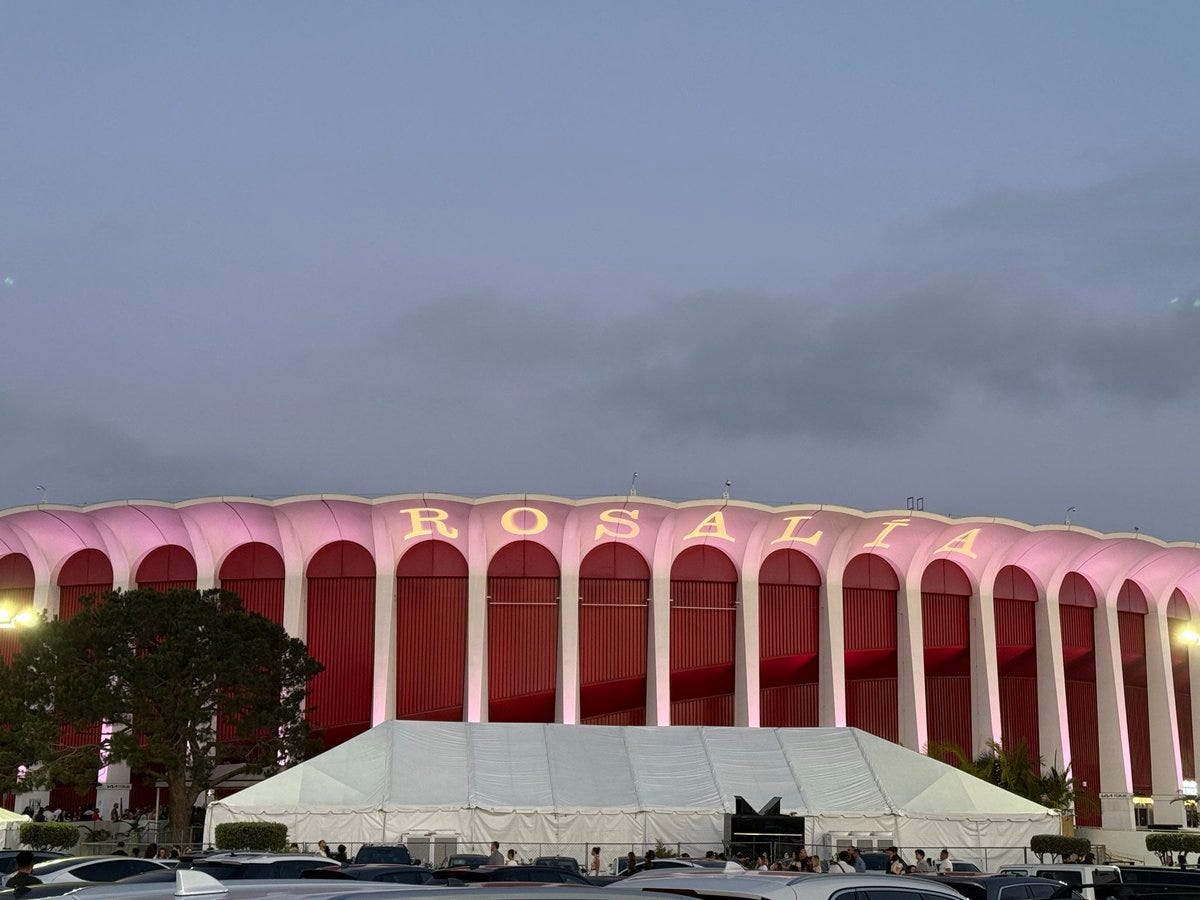
Her conservatory-trained voice is an event in itself. It is possessed of a dominance and a mysticism, particularly on the likes of “El Redentor”, which would usually be more suited to a public procession during a Semana Santa. I found myself in a state of weeping worship watching her seductively wrap herself with discipline around her take on an Italian aria (“Mio Cristo Piange Diamanti”), before throttling the crowd with the volatile, dramatic “Berghain”. She is beyond type, beyond genre. Poetry in mesmering motion.
The choreography is thrilling. The wardrobe is Dior; the most couture religious garb since Baz Luhrmann’s Romeo + Juliet. There is an orchestra on a second stage in the middle of the floor. In one moment, you could be watching a classical concert, and minutes later you are at a strobe-lit reggaeton rave with a female dreadlocked maestro who is dancing in rapture. What I found almost irritatingly good about the performance was the melding of high concept art with easy fun and whimsy. If nothing registered with you, you would still leave smiling from ear to ear. It’s a show that works for basic bitches who think “Sauvignon Blanc” is an ode to wine, and it’s a show that works for lipstick lesbians with PhDs in the divine feminine.
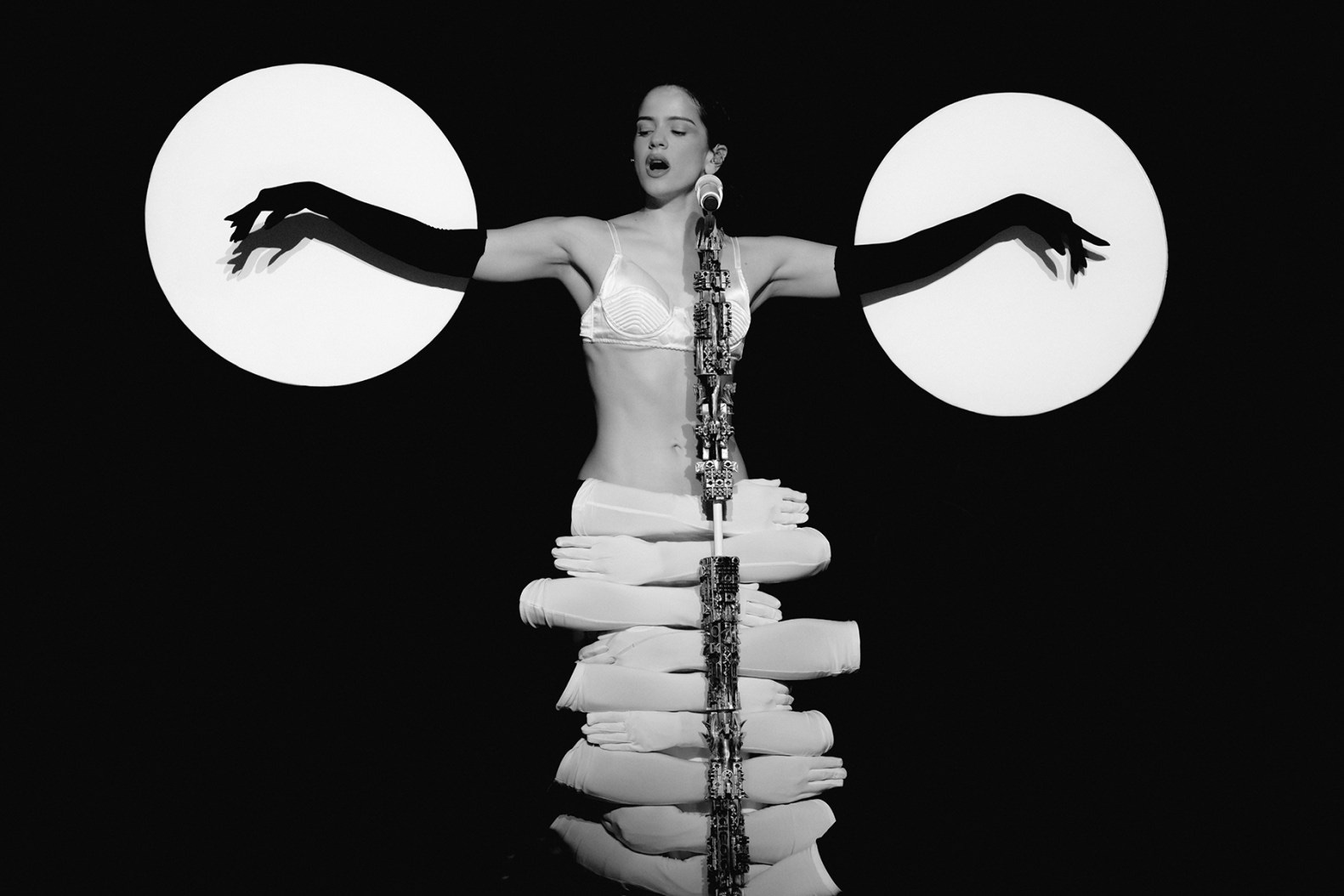
Rosalía has cited inspiration from Spanish poet Alana Portero who encourages prayer, even in absence of belief. Portero speaks of “projecting yourself toward what’s beyond you.” In her art, Rosalía sacrifices all of her past to the crowd, but she does not protest her place, or show how hard it was to get here. She does no preaching. She merely inhabits her own vision and in her execution she just so happens to exalt herself above any living performer today.
She is a pop star. Her job is to make popular art. She has made a physical music from all the beauty that remains. In language, in movement, in her mind’s eye. There is so much offered.Is she the antidote to atheism? I wondered, considering how she made this with the belief that it could be popular. Godliness is not ritual. It is not about rules. It’s about connection that expands outward as shared humanity. It generates transcendence. “Quepo en el mundo y el mundo cabe en mí,” she sings. I fit in the world, and the world fits in me.
As I left the Forum, I thought of Kate Bush: “If I only could make a deal with God, and get him to swap our places.” Rosalía’s gateway presents no answers. Instead more questions. Funny really because is that not why we struggle with God?
To support Blacklisted, please subcscribe for $10/month or $100/year.
I'm with Dave. You are such a phenomenal music writer. As a non-music person, you draw me in. I always learn so much from you, no matter the topic, but I can feel your love of music ooze out of you when you write about it.
Selfishly, I love when you write about music. You’re so good at it. Thanks for this piece. I was fortunate to see her at MSG last month. I wasn’t sure what I expected to see, hear, or feel, but she exceeded everything.