Hard for Hate
The perils of Grindr for gay Jews

The argument goes that fetish is about liberation, but if that’s the case why is Jew hatred such a kink? Forget bondage, forget role play, forget sensory deprivation, the master just wants a dirty little Jew. Jew hatred has long been sexual in its nature. I have written at length about how pornographic it is in its intensity, much like the misogyny we experience online, in fact. Mocking women and haranguing Jews has this perverted thrill to it that carries a familiar feeling of being forced into submission, without consent. It feels like sexual abuse. Perverts like to play with our pain for their own cheap thrills.
I don’t have to imagine the masturbatory nature of the hatred I receive due to the daily responses in my social media that live all over the internet, publicly. It’s intended to shame me, to degrade me, to humiliate and control me. In the last year there has been an uptick in daily abuse towards me from actual pornographers on X. When I click on their hate speech to learn more about where they came from, I’ll find a watermelon emoji, and a feed full of self-tapes of hardcore pornography. Jew hate is not merely a glory hole where homophobia fucks misogyny, it’s like a sex dungeon for men, women, gay, lesbian, transgender, bi, who have internalized their own hatred and get off on dominating society’s favorite victim: the Jew.
For the LGBTQ+ community, the deviance is even more prevalent, because hook-up culture easily becomes a predator’s paradise. And given how inherently political the LGBTQ+ world has rendered itself, Palestine has become an upfront preference intimately as well as at the Pride parade. Paragraphs have been written by Zionists about why we have not felt safe at Pride parades for a decade, for some longer. The first woman I thought I loved got off on ideologically defining herself against my Jewishness, setting the rules for what I could say and think. Too bad I’m such a brat. The most hedonistic and self-flagellating variety of this delinquency that targeted me came from the new generation of trans ideologues. Never has the most intimate part of my life been so abused as when the self-proclaimed “most oppressed” in society decided that a Jew cannot be a lesbian if we are for Israel; that a Jew cannot be gay if we are proudly Jewish. Rainbow declined. Float captured.
When a close friend found out I was relieved with Trump winning the last election, the lashing-out came: “Last time I checked you were gay!” I thought: How dare you tell me how to live as a gay, Jewish woman. It felt homophobic. It felt shaming. I await an apology. Liberalism is not liberal any more. Our sexuality is not your political football. Our religion is not your political football. Our survival is not your political football. If you cannot condemn the kind of hatred that my best friend and author Ben M Freeman is about to describe to you below, then how are you any better than the people you hate? Jews have been pushed out of society because that became their only source of power. It became their fetish. They have a hard-on for Hitlerism. I spend my evenings recently inside the late 2000s watching re-runs of The L Word. It feels like the safest cleanest way to access a part of me that no longer has a place to go.
Ben has found it rudimentary to be abused for being a Jew on the gay dating app Grindr; the same app where reportedly in Australia gangs of Islamists have been luring teenage Jewish gay men to public places to capture beating them up on video. Over to Ben…
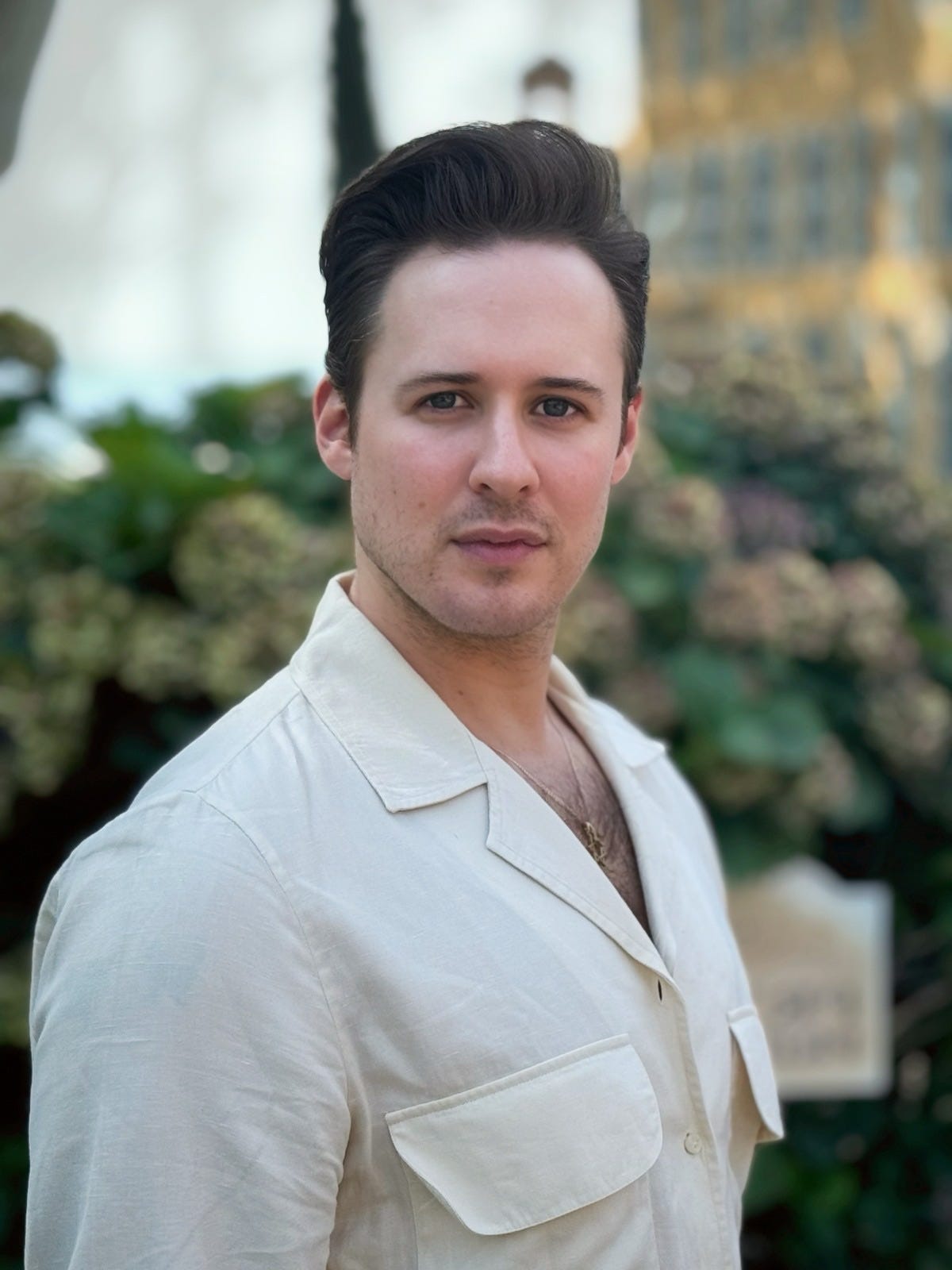
For most of my thirties, I was in a long-term monogamous relationship. During those years, I watched from a distance as parts of the gay community began to descend into something darker, something more ideological, and increasingly hostile toward Jews. I could see it in the rhetoric, in the spaces I once felt connected to, in the language that was becoming normalized. But it remained, for me, somewhat abstract. I was not in those environments directly. I was not navigating them as a single man. I was observing, analysing, understanding. I was not yet experiencing.
That changed when my relationship ended and I found myself single again.
Moving back to Scotland and living by myself, I began, cautiously, to re-enter the gay dating world. There was some hesitation, not just about dating, but about the kind of spaces I knew I would be stepping back into. My approach to life has always been to be upfront. I do not believe in hiding who I am to make others comfortable. So I made a decision early on. I would make my Jewish identity visible. Sometimes I would include an Israeli flag in my bio. Sometimes a Star of David. Nothing confrontational. Nothing political. Just a clear statement of who I am.
I assumed that this would act as a filter. That those who had a problem with Jews would simply not engage. Maybe they would ignore me. Maybe they would block me. That seemed reasonable. That is how most people navigate differences in these spaces. What I was not prepared for was the extent to which people would actively seek me out. Not to connect, not to ask, not even to challenge in good faith. But to abuse.
It did not take long before it started. Messages from accounts I had never interacted with. No greeting. No context. Just hostility. Anti-Jewish slurs, accusations, moral condemnation delivered with complete confidence by strangers who knew nothing about me beyond the fact that I am a Jew. There is something deeply revealing in that. The impulse is not reactive. It is proactive. They are not responding to something I have said. They are responding to what I am.
Last night, it happened again. A message from a random account I had never spoken to, telling me I should be ashamed for supporting genocide. The accusation was immediate and absolute. There was no attempt to ask what I believed, no curiosity, no engagement. And the reality is, there was nothing in my profile that even referenced Israel. No political statements. No mention of Zionism. Just a Star of David. That alone was enough to trigger it.
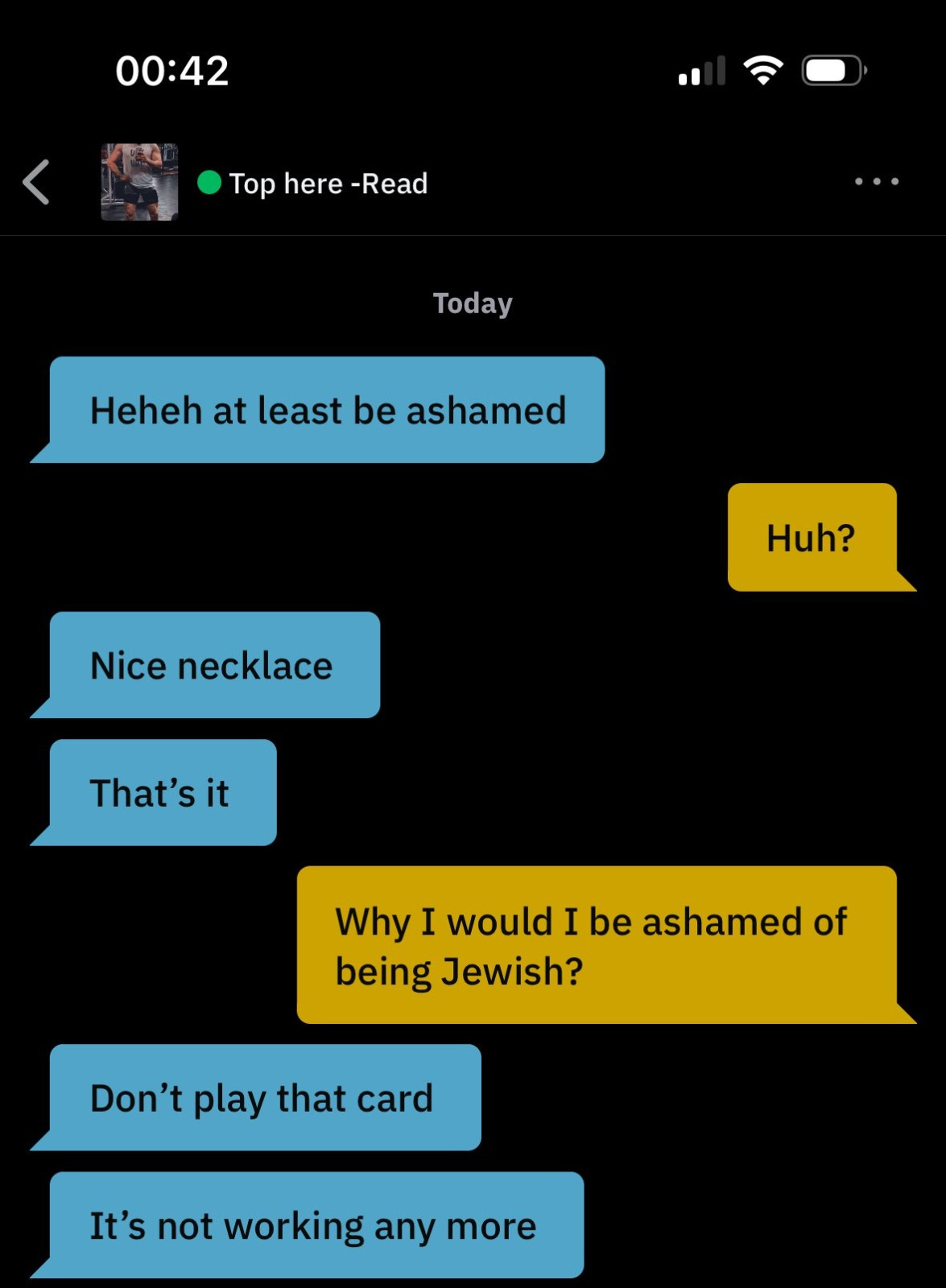
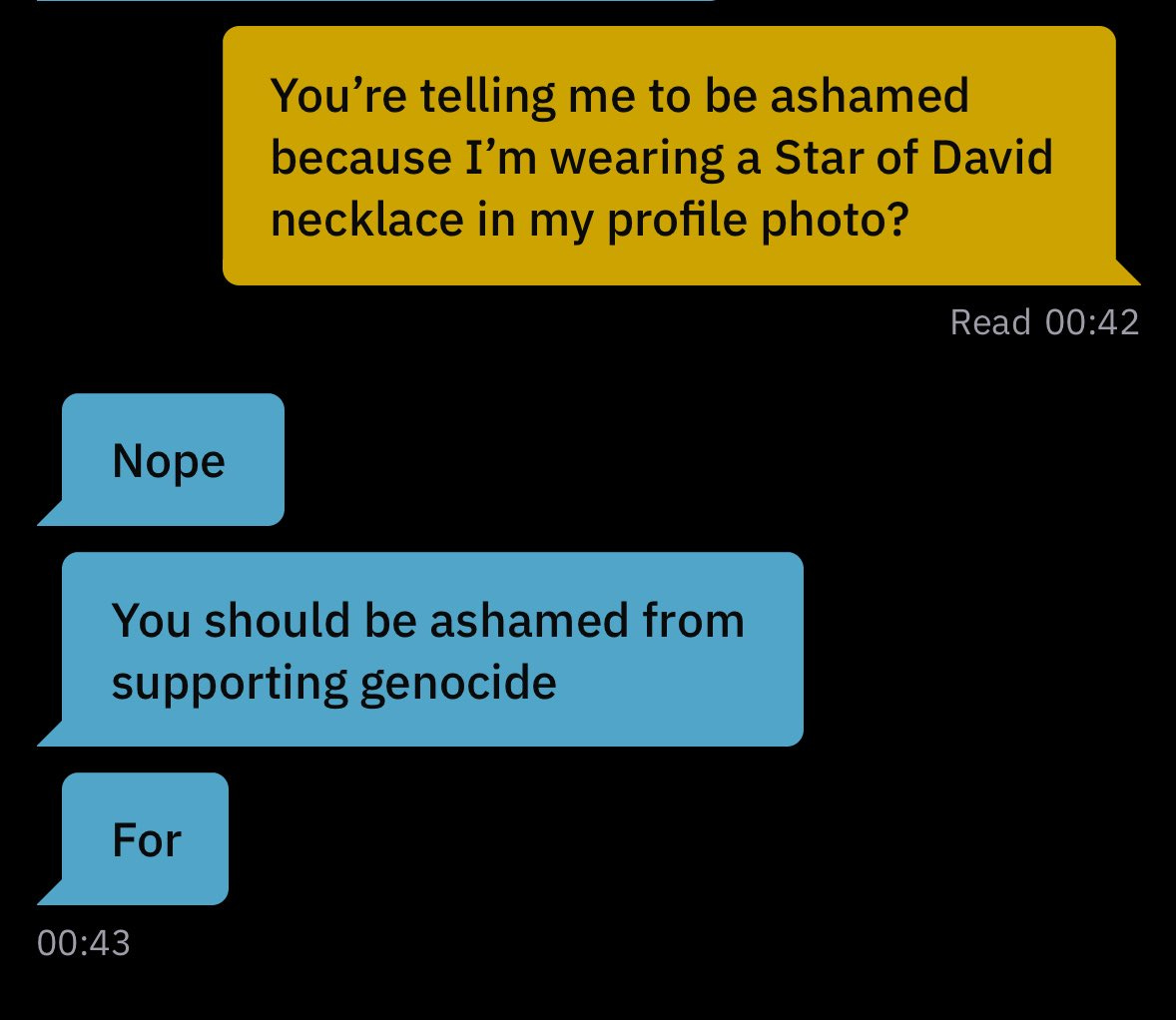
That is what this has become. Jewish identity itself is treated as a political provocation. As something that demands a response, and increasingly, a hostile one. I was not targeted because of an argument I made or a position I expressed. I was targeted because I am a Jew, visibly so, and therefore, in their minds, guilty.
This is not an isolated experience. It has happened repeatedly. I have been told that Israel has no right to exist, as if that is an acceptable thing to say to a Jewish stranger on a dating app. I have been told that Jews are now doing to others what was once done to us, the Holocaust casually repurposed as a weapon to attack Jews. I have received messages that cross the line from hostility into something far more explicit, openly genocidal in their language, justified by a moral framework that casts Jews as uniquely deserving of condemnation. And then there are the numerous people who put “No Zionazis” or “No Zionists” in their profiles, alongside watermelon emojis, contributing to a culture of hostility in which exclusion of Jews is normalised, and recast as something virtuous.
But it is not only the overt hostility. It is the entitlement. The assumption that non-Jews have the right to define Jewish identity for me, to tell me what it means to be a Zionist, to explain my own history back to me as if I am the one who has misunderstood it. Conversations where I am not spoken to, but spoken over. Where my voice is not engaged with, but dismissed in advance. Where Jewish identity is treated as something external, something available to be interpreted, reshaped, and ultimately judged by those outside of it.
And beneath all of this is something even more basic. It is racism. Plain and simple. The reduction of a people to a set of accusations, the denial of our right to define ourselves, the insistence that we must fit into categories constructed by others. It is delivered in the language of politics, of justice, of progress. But strip that away, and what remains is familiar.
One of the most striking patterns is the use of the word “Nazi.” Being called a Nazi by a non-Jew has become almost routine. But what stands out is not just the accusation itself, but the tone in which it is delivered. There is often a sense of satisfaction, even excitement. As if they have found the ultimate rhetorical weapon. The ultimate inversion. The Jew as Nazi. It is presented as a moment of moral triumph. You can feel it in the way it is written, in the eagerness to deploy it. There is a kind of pleasure in it, in taking Jewish history, Jewish trauma, and turning it against Jews. It is not about historical understanding or moral consistency. It is about humiliation. About power.
Then there are the conversations that begin normally and slowly reveal the same underlying dynamic. You speak for an hour, sometimes longer. It feels, on the surface, like a genuine interaction. And then it comes.
“Can I ask you a question?”
I always know what is coming. It is never really a question. It is a test.
“Are you a Zionist?”
I have answered this more times than I can count. As an educator, I respond calmly, often through voice notes. I explain that Zionism is the Jewish indigenous rights movement, rooted in thousands of years of history, continuity, and connection to the land of Israel. I explain that it does not negate Palestinian identity or rights, that it does not inherently oppose a two-state solution, that it is, at its core, about Jewish self-determination. And still, it makes no difference.
“Sorry, you lost me at two-state solution.”
That response stays with me because it strips away the pretence. It exposes what is really happening. This is not about nuance. It is not about peace. It is not about supporting Palestinians in any meaningful sense. Because if it were, a two-state solution would not be a dealbreaker. It would be a baseline.
What is being rejected is not a policy position. It is Jewish legitimacy. This is why these interactions feel so familiar, even as they unfold in spaces that once promised acceptance. Gay Jews have spent decades fighting to exist openly, to claim pride in who they are, to build a sense of belonging in a world that often told them they were wrong, immoral, or unwelcome. And now, in those very spaces, many are being told exactly that again. That there is something fundamentally unacceptable about them. That they must choose between parts of their identity. That their Jewishness, or their connection to Jewish peoplehood, renders them suspect and amoral.
What we are seeing is the outcome of a broader ideological shift within the Left. Over time, a framework has taken hold that divides the world into oppressors and oppressed, assigning moral value accordingly. This framework emerged out of post-colonial thought and the evolution of the New Left, replacing earlier models of analysis with a rigid, identity-based moral hierarchy. In theory, it is meant to highlight injustice. In practice, it flattens complexity and predetermines conclusions.
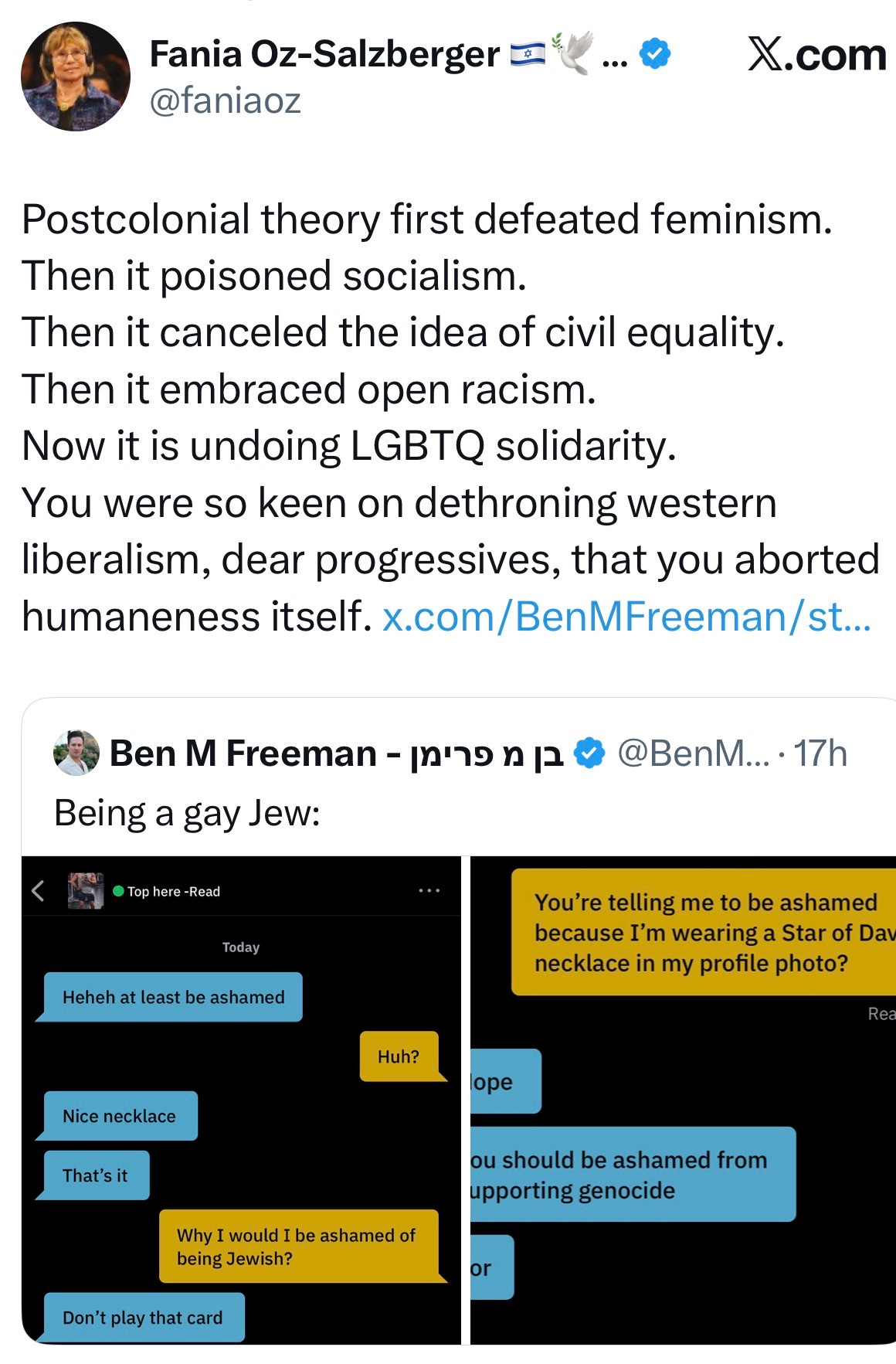
Within this framework, Jews, and particularly Israel, are cast as the oppressor. Palestinians are cast as the oppressed. Once those roles are assigned, everything else follows. Evidence becomes secondary. Context becomes irrelevant. Moral judgment is no longer something to be explored, but something that is already decided.
This is how you end up with “queers for Palestine,” a movement that, on its face, appears paradoxical. Individuals aligning themselves with a cause that, in reality, stands in direct opposition to many of the rights they claim to defend. But within this ideological structure, it makes perfect sense. The category of “oppressed” overrides all other considerations. The actual beliefs, actions, and values of the actors involved become irrelevant. And Jews, once again, are positioned outside the moral community.
What I encountered on those apps is not separate from this. It is a direct expression of it. The personal and the ideological are not distinct here. They are intertwined. The message from the stranger, the accusation, the question about Zionism, the rejection of even the possibility of coexistence, all of it flows from the same source.
It is not random. It is not accidental. It is the logical endpoint of a worldview that has no place for Jews as a legitimate people. And when that worldview takes hold in spaces that once promised safety, the result is not just political disagreement. It is exclusion. It is hostility. It is the quiet, and sometimes not so quiet, message that Jews do not belong.
And there is also a quieter consequence to all of this. One that is less visible, but no less real. It is the isolation. There are moments when that isolation becomes particularly sharp. Times when I realise how starved I am of something as simple as ease. Of speaking to another gay man without being tested, without being interrogated, without my identity being turned into a political battleground. There have been nights where I have changed my location to Tel Aviv, not because I am there, but because I know that in that space, I can speak to other gay Jews who will not abuse me, who will not question my legitimacy, who will not demand that I justify my existence before a conversation can even begin. That in itself says something profound.
I am also aware that my experience is not only my own. I am a public figure. An openly gay Jew. People know who I am. Young Jews message me from all over the world. They come to my events, often quietly, sometimes nervously, and they ask me how to deal with exactly this. The hostility. The questioning. The feeling that they must choose between who they are and where they belong.
This is my area of expertise. I study Jew-hate. I write about it. I understand what is happening, even when it is personal. But what about those who do not? Those who do not have the language or the distance to make sense of it? The younger ones, navigating this for the first time, being told there is something wrong with them. The consequences are not abstract. They are personal. And they can be devastating.
But I tell them what I believe to be true. That they need to find their Jewish gay community. That it exists. That there are spaces where they can be whole, where they do not have to fragment themselves to be accepted. Because there is no choice to be made. They are who they are. And any space that demands they leave part of themselves at the door is not a space of inclusion, but exclusion.
And that is the reality we are now confronting. Not a disagreement, not a debate, but a system of thought that places Jews outside the boundaries of acceptable identity unless they conform. This may be a specific battleground, but it is part of a much wider war currently being waged against the Jews.
I will not fragment myself to meet that demand. Because any space that requires Jews to dilute, deny, or defend their existence is not progressive. It is regressive. And history has seen it before.
Ben M. Freeman is the founder of the modern Jewish Pride movement and one of the premier Jewish public intellectuals of his generation. He is the author of the groundbreaking Jewish Pride: Rebuilding a People (2021), Reclaiming Our Story (2022), and The Jews: An Indigenous People (2025), the first ever book to directly address and definitively prove that Jews are indigenous to the Land of Israel. A Holocaust scholar for more than fifteen years, Freeman rose to prominence during the Corbyn Labour crisis in the United Kingdom and quickly became a central figure in contemporary discussions of Jewish peoplehood and experience. He was ranked number 8 on the inaugural 25 Young ViZionaries list by The Jerusalem Post and JNF USA, serves as a Jewish Diplomat for the World Jewish Congress, and is a Research Fellow at the Elizabeth and Tony Comper Interdisciplinary Center at the University of Haifa.
To support Ben, please head over to his X account or Instagram
To support Blacklisted, please subscribe for $10/month or $100/year
(Sidenote: Earlier this month, Sapir Journal published my piece Queers For Zion. Stay tuned for the YouTube link to my conversation with Editor-In-Chief Bret Stephens, as we have a one-hour discussion on the issues there)
There are no words Eve. My parents generation knew antisemitism and knew what it was like to be a Jew in America. My Dad used to say he hated when school ended because he had to run like crazy to avoid the “Irish kids.” If they caught him, they’d beat the hell of him because he was Jewish. He was raised in the Bronx.
So he and Mom moved us to a Long Island community that was 95% Jewish and then I went to Boston University which was 30% Jewish. I used to tell my Dad, that the days of Jews getting beat up because they were Jews were over. Of course,he laughed and told me I was just sheltered. He was right of course.
Now what? We do what our ancestors did. 5,000 years of this crap but we continued to cling to our Jewishness, our traditions, our pride in all Jewish accomplishments. The only solace is our people will be here long after these anti-Semitic, hateful people. Karma will find them.
Hang in there Eve. I support you 100% and all my NY Jewish friends do too.
Hashem yevarech et ha'am ha'yehudi
The "ideological shift" Ben mentions is generally called woke ideology, and alas, it is the prevailing ideology in the left, including the LGBT community. This ideology, I argue, is poisonous. It arbitrarily defines "oppressed" and "oppressor" according to immutable characteristics: race, ethnicity, national origin, and sexual orientation. It takes no account of human agency or free moral choice. Ultimately, it is Marxism with a veneer of identity politics. It is illiberal, and meant to undermine the West. Ben and Eve have been redefined, categorized, and declared "guilty" simply for being born Jewish. This ideology is indeed racist and bigoted. Confidential to Ben, sorry for being a Yenta, but I hope you find the man of your dreams, and he should only have the moral clarity of a Douglas Murray.